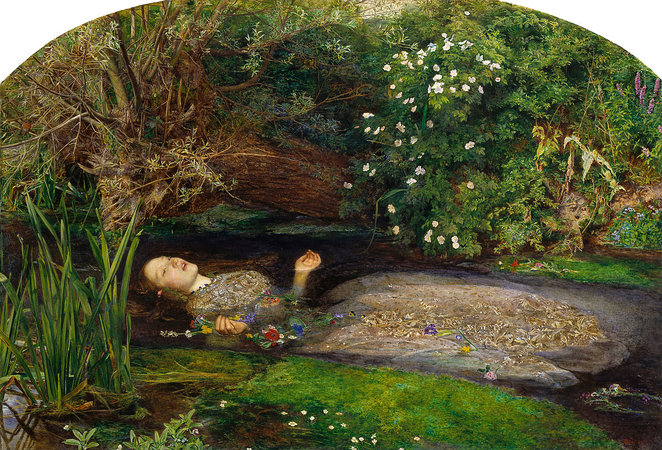
The sex and death, light and dark link is very prominent in literature and mythology, and the two are often rightfully placed side by side. A prominent story of the young Maiden Persephone. This is such a romantic vivid invoking story amongst people even of the modern age. Persephone represents everything that is good, pure, she is virginal, a maiden, she is light embodied, she represents the phase between birth and the experiencing of life. She is stolen and taken to the underworld by the God of the underworld, Hades. Hades in this instance represents the darkness, death, the unknown, the unconscious, the other world. Their sacred marraige, sexual union, the corruption of Persephone, lasting six months a year, is a symbol of the young soul venturing into the darkest depths of one's self where darkness, death, spirits, ghosts reside and emerging forth brightly again into the conscious mind empowered, vibrant, glorious radiant, shining with the knowledge gained from before, one big sexual spiritual metaphor. There are similar allegories of the Goddess descending into the depths of
the underworld to align either with oneself or the dark God, Inanna, Ishtar, descending as does the shining planet of Venus in the night sky into the dark depths below the horizon to emerge once again, reborn into a new cycle. Psyche is also a young beautiful maiden who comes into an otherworldly sexual union with Eros in the depths of darkness, forbidden from looking upon her lover as they explore their sacred sexuality with one another, she journeys into the realm of Elysium, the otherworld, the subconscious, the darkness. The allure of darkness and light emerging in sexual union has inspired authors, artists, poets for centuries. The same dualistic theme is similar in the love affair of Aphrodite and Ares, the entanglement of love and war, a goddess of things light, love and childbirth, a God of things dark, violence and rage and war, the female harbinger of sexuality, life and rebirth and the male harbinger of death, darkness, the violence of sexual libido, a dangerous irresistible love affair. This style of romance is so ingrained in our minds, so symbolic and we are so drawn to it because not only does it represent part of ourselves coming together but the different states, processes in our lives that everybody faces. This compulsion to engage in sex, to stare death in the face, to lose ourselves, our sense of time, of self, for but a moment is both natural and essential to fully understand oneself, to live, to experience the depths of our psyche.
The prominence of Thanatos, this death drive, the intrigue of death and darkness and its arousing close association with sexuality contributes to the eroticised experiences of creatures of the night, the dark denizens hidden within the shadows that we are mortally drawn to and whom are equally ensnared by us, like a moth to a candle flame, for we are the opposite to them. There are so many similar beings in different cultures and lore of a dark body that pries upon us sexually, that draws our life force and although we humans fear them we can't resist them either, terrifying and beautiful. There are the succubi who emerge through the door of the netherworld within our journeys to the otherside in our sleeping state. Nightmarish in their tellings, female demons who have sexual intercourse with sleeping men, equally the Incubus the male counterpart.Their goal is to reproduce, either by collecting semen or impregnating innocent women. Although frightening and demonic these beings are often portrayed in all forms of art in an erotic manner, as attractive, voluptuous or sexualised, or alternatively as a goblin like creature but still placed beside eroticised pictures of young female victims. This parallels the mysteries and old tale of the hapless maiden Persephone being wooed by Hades in the dark underworld where she births their offspring.
Vampires were also a horrible grim creature, defintely thought of as ugly, decaying human monsters arisen from beyond the grave. People used to go to desparate measures to prevent these creatures from rising, steaking them to the ground, weighing them with stones, there was an apparent paranoia, the idea that something could one day rise beyond the grave and yearn for a taste of the living, their life force and energies, was so real enough that that they took action against it, a public acceptance of a belief. But overtime the vampire has become another undead subject of romanticism. Bram Stoker's Dracula helped formulate the modern lore of vampirism we know today, Dracula craved a mortal maiden Mina and she eventually is hypnotised by his spell. It holds the symbolism of life and death craving to come together in sexual union, the same partnership eternal in our folklore.
“His face was a strong, a very strong, aquiline, with high bridge of the thin nose and peculiarly arched nostrils, with lofty domed forehead, and hair growing scantily round the temples but profusely elsewhere. His eyebrows were very massive, almost meeting over the nose, and with bushy hair that seemed to curl in its own profusion. The mouth, so far as I could see it under the heavy moustache, was fixed and rather cruel-looking, with peculiarly sharp white teeth. These protruded over the lips, whose remarkable ruddiness showed astonishing vitality in a man of his years. For the rest, his ears were pale, and at the tops extremely pointed. The chin was broad and strong, and the cheeks firm though thin. The general effect was one of extraordinary pallor.
Hitherto I had noticed the backs of his hands as they lay on his knees in the firelight, and they had seemed rather white and fine. But seeing them now close to me, I could not but notice that they were rather coarse, broad, with squat fingers. Strange to say, there were hairs in the centre of the palm. The nails were long and fine, and cut to a sharp point. As the Count leaned over me and his hands touched me, I could not repress a shudder. It may have been that his breath was rank, but a horrible feeling of nausea came over me, which, do what I would, I could not conceal." - Bram Stoker, Dracula
Even though Dracula is described as far from attractive by anyone's ideals the allure of a vampire with unnatural qualities and abilities, who can turn us to lover or pray on its whim is desirable. Today's portrayals of vampires are ones of sexy, film star like people with an unearthly beauty and a thirst, for not just our blood but to copsulate with us, that can not be quenched.
More creatures arise from the dark waters of chaos and sexuality such as the mermaid, the siren, erotic, breathtaking women who would appeal to their male prey, seducing them before dragging them deep into their watery grave. The link between sex and death, light and dark, coming together in the waters of the otherworld, or the subconscious, and our desire to reach these planes of terrifying but blissful states, the Elysium we all strive for, is irresistible even at the cost of death.
The Fisherman and the Siren, by Frederic Leighton, 1856-1858
Even nature spirits such as nymphs and dryads, beautiful feminine beings one can compare to the God's and Goddesses, caretakers of the realm, beings of both light and nature, the living, are sometimes savage and dangerous to encounter. Take Orpheus, his fate was to be torn apart by Maenad's, the female followers of the Nature God of wine, ecstasy and intoxication, Dionysis. The trials of Orpheus are even venturing the tenuous line of death and mortality by venturing to the underworld in order to unite with his fallen lover. The fate of Hylas, who encounters a nymph while fetching water from a pool, is not revealed but one can imagine it either ends in drowning less likely romantically, however the theme of seduction and the otherworld are still prominent subjects.
Death of Orpheus, by Émile Lévy, 1866
Similarly maidens of light, godliness, sexuality, purity and innocence are also erotic and invoke our sexual instinct and in tandem our urge to connect with spirit and the otherworld.
Swan maidens are prominent in Northern European folklore and mythology. The tale of Angus and the swan maiden tells us of a hero whom in his dream state envisions a beautiful maiden whom he falls in love with. However she is a shapeshifter who changes form between a swan and a woman. Angus has to distinguish her amongst other swans on a particular night, or else she would remain so for twelve months, and propose to her. The imagery is angelic, pure, beautiful and encourages us to travel beyond the realms of the norm and seek out blissful union in an otherwordly state. Swan maidens have guided male characters in folklore, the imagery so profound to our mortal selves.
"In fact, European folkore abounds in stories of fairy-like swan maidens who usually appear in group of three, or seven. Stories handed down across countless generations thell of them arriving at a lake where they remover their swan shift (or 'wings') and swan ring (that is, a necklace, like Caer's gold chain), which is left behind in the grass. A peasant then comes along and, on seeing the women, steals their belongings and watches from a safe distance. Once the maidens tire of their play, they approach the man and ask for return of what is theirs, at which he requests that if one one of them becomes his wife, then the others might also go free. This then occurs, enabling the peasant and swan-maiden to live as man and wife for seven years, until he shows her, or she finds, the shift and ring that he has concealed for all this time. On holding these she immediately makes her escape, causing her husband to die of heartbreak"- Andrew Collins, The Cygnus Mystery
These teasing, beautiful, pure, elusive maidens are so magical and tempting their tales aren't just bound to Europe.
"All over Europe, and across Asia alsom the tale is more or less the same".- Andrew Collins, The Cygnus Mystery
In his book, The Cygnus Mystery, Andrew Collins presents an interesting, persuasive, thought provoking hypothesis that these maidens are likened to swans as they are a part of a neolithic global shamanic religion that see the swan as the guide to through the milkyway into the cosmic afterlife, a symbol of a ferryman of souls, a psychopomp, due to the constellation of Cygnus alligning in the milkyway, the waters of chaos, of rebirth, of life and death, and therefore these young fertile maidens symbolise beings from this cosmic, otherworld, they are beautiful and alluring as they represent our desire to travel, to experience beyond our dimension, and that experience, that worshipping of the otherworld and the afterlife is eternally linked to our drive to live, experience, reproduce, our sexual drive. Proof of the swan being a symbol of the after life, or the other world, is also described by Andrew Collins, I recommend reading his book, but here is but one example:
"Traditions of this sort hark back to an age when magical flight was thought to be attained by the male or female shaman through wearing either a cloak of swan feathers or other swan paraphernalia, evidence of which occurs in these same countries, and also in many parts of Asia and the Indian sub-continent, where swan veneration was prominent in the past. Moreover, in Denmark archaeologists have discovered a unique burial in a cemetery dating to the Mesolithic age, c. 4800 BC. A young woman was found beneath a small knoll, next to her dead child, who had been laid to rest on a swan's wing. Its striking presence has been seen by some archaeologists as evidence of a link between the swan and the transmigration of the soul. If correct it shows the antiquity of this cult, which preceded even the spread of Europe's megalithic culture, of which both Avebury and Newgrange are prime examples.
Yet the connection between swan-maidens and prehistoric tombs is not confined to Newgrange, for at the Wayland Smithy long barrow situated some 40 kilometres (25 miles) from Avebury, a legend connects the founder Wayland, or Weland, the Germanic and Norse divine smith, with the cult of the swan. It was written that he escaped from the labours imposed on him by the wicked king Niðuð by wearing a swan coat, enabling him to achieve magical flight. In some versions of the tale, this was given to him by his wife, who was a Valkyrie. They were female spirits, shape-shifting swan-maidens, who carried the souls of the dead to Valhalla, the Hall of the Heroes in Norse myth. Although Wayland's link with the monument that bears his name post-dates its construction by some 4,000 years, it cannot be coincidence that, quite separately, prehistorian Professor John North determined that Wayland Smithy is aligned to Deneb, suggesting that a swan cult existed here as early as c. 3700 BC, its accepted date of construction."- Andrew Collins, The Cygnus Mystery, article on his website: http://www.andrewcollins.com/page/articles/thecygnusmystery_knights.htm
Another light being, closely meandering the road between sexuality and death, is that of the beautiful Valkyries from Norse mythology. The valkyries are a host of maidens who determine both whom dies and who lives in battle, their name meaning "chooser of the slain", who use their "malicious magic to ensure that their preferences in this regard are brought to fruition".
"In the religion of the Norsemen, swans were seen as Valkyries, shapeshifting female warriors, gathering around the God Odin and his wife Freya in Valhalla, where slain warriors are recieved into the afterlife. Indeed valkyries were the 'conductors of souls to the lands of shades'. Belief in their visitations to the physical world were widepread in he scandinavian countries, where ancient tradition speaks of maidens adorning themselves..."
- Andrew Collins, The Cygnus Mysterey
Often compared too with swans, or horses, they are empowered, beautiful ladies who not only exist beyond the veil they hold the reigns on the livelihood of men, literally deciding who lives and who dies, sex and death embodied, whom sometimes fall in love with heroes and men alike.
"The meeting of two personalities is like the contact of two
chemical substances: if there is any reaction, both are transformed.
"- Carl Jung
Ultimately it is the attraction, the draw, the impulse we each have to explore, to lose oneself in sexual activity that beckons us towards connecting to the divine, walking the footsteps of Gods and fantastical beings alike, to enact the throes of heroes, of demons, of human beings, of particles alike, an intrinsic part of our very being, our very psyche which helps us understand ourselves and hand in hand come to terms with the aging of our being, the maturing of our soul, the demise of our simply physical, material selves, but an invitation to experience the floodgates of the world beyond the veil, to open our eyes to ecstatic realities full of beautiful maidens, of heroic knights, of dark sultry demons, incubi, succubi, vampires, of men and women so sexual, so irrestible every fibre of our being can not deny the impulse to align the light with the darkness, a journey of self discovery for "one does not become enlightened by imagining figures of light, but by making the darkness conscious"-
Carl Jung, a human experience from one to another, no matter how drunken, how debaucherous, how raunchy we are all learning, experiencing, living, creating, uniting our primal animal with our enlightened oneness, "To confront a person with his own shadow is to show him his own light"-
Carl Jung.
Perhaps this urge to unite the darkness with the light, the sexual with the otherworld beyond,
is where fetishes are born, people diving into the depths of their darkness, the Thanatos taking over, sado-masochism born by experiencing our own mortality literally as we experience the sense of self gained through sex, the release of a drive that governs our waking moment for it defines what it is to be alive.
Perhaps this merging, this willingness to submit, to perform this act aware of the barrier breaking, transcendental sense of being, is so frightening we fashion images of maidens corrupted by their desires, the whore is so self empowered, so awake in her divinity, her sexual awakening, we fear her, make her monstrous, paint her as the whore of Babylon. We are so scared of mortality, of living, we curse the primordial Eve, Lilith, for teaching us that we are mortal, that we are sexual beings, that we can die, experience more than this safe bubble of reality. We curse her and the serpent, the very symbol of knowledge, of the pineal, of the rising energy of the Kundalini which is risen by the very act of being, of existing, by reaching transcendental experiences in whatever medium YOU find fit for your purpose, INCLUDING sex. We have demonised the old, ancient, sacred, enlightened priestess who guided us, who sustained us with her living fluids, her sexual energies. Paint her as a whore:
"The ’Scarlet Women’ were so called
because of their being a direct source of the priestly Star Fire. They
were known in Greek as the Hierodulai (’Sacred Women’) - a word later
transformed (via mediaeval French into English) to ’harlot’. In the
early Germanic tongue, they were known as Horés - which was later
Anglicised to ’whores’. However, the word originally meant, quite
simply, ’Beloved Ones’. As pointed out in good etymological
dictionaries, these words were descriptions of high veneration and were
never interchangeable with such words as ’prostitute’ or ’adulteress’.
Their now common association was, in fact, a wholly contrived strategy
of the mediaeval Roman Church in its bid to denigrate the noble status
of the sacred priestess."- Laurence Gardner
Lilith, by John Collier, 1892
To engage in the act of sex is a natural, empowering experience, we are programmed to do so, it is hardwired deep in our subconscious, whether that be with a loving partner where you can awaken the depths of eachother, experience romantic bliss, or even a stranger. Life is about experience, and sex is the ultimate link to living for it is spiritually and psychologically connected to dying, and the more prepared we are for our travels, our journey to the fields of Elysium, the less we have to live in fear, denying and imprisoning apart of ourselves into the tales of history, into the twisted mythology of monsters. Live, experience, love, make love, dream, go beyong the veil, walk on the shoulders of Giants.
"Through spiritual unfoldment and knowledge imparted by the Mysteries,
however, the latent element in each nature is gradually brought into
activity and ultimately the human being thus regains sexual equilibrium.
By this theory woman is elevated from the position of being man's
errant part to one of complete equality. From this point of view,
marriage is regarded as a companionship in which two complete
individualities manifesting opposite polarities are brought into
association that each may thereby awaken the qualities latent in the
other and thus assist in the attainment of individual completeness."- Manly P Hall, The Secret Teachings of All Ages
So please, go forward, my fellow journey men, be conscious that you are alive, experience the wonders of nature, of material existence, the ecstasy in your sexual empowerment, the freedom to love and unite with another, there is nothing more divine than being truly in love with someone and exploring that relationship. Awaken the darkness and balance it with your light, travel to worlds beyong and love yourself and another. Be conscious of this bond, for "man is not truly one, but
truly two,”-
Robert Louis Stevenson, The Strange Case of Dr Jeckyll and Mr. Hyde.Safe journey on your travels, and to you, Namaste.
Freya Rose
)O(
References/ Sources
Books:
Genesis of the Grail Kings- Laurence Gardner
Realm of The Ring Lords- Laurence Gardner
The Cygnus Mystery- Andrew Collins
The Secret Teachings of All Ages- Manly P Hall
Bram Stoker- Dracula
The Strange Case of Dr Jeckyll and Mr. Hyde- Robert Louis Stevenson
Websites:
Bigmyth.com
industry-couldnt-get-worse/
https://thoughtsfromthemiddleseat.com/2011/02/28/explaining-thanatos-the-death-drive/
http://www.andrewcollins.com/page/articles/thecygnusmystery_knights.htm
http://www.bcliving.ca/health/5-surprising-ways-sexy-time-is-practiced-around-the-world