Showing posts with label folklore. Show all posts

Thursday, 8 December 2016

Yule Lore: The coming of the Sun God

Yule Lore: The Coming of the Sun God

Of The Oak and Holly King, Birth of The Sun God, The God and The Goddess, Holly and Ivy and other Yule Traditions and Lore

The Oak King and The Holly King, by Anne Stokes, http://www.annestokes.com/

The nights have began to darken, the frost is creeping in and the paving flags are glittering. Autumn is phasing out and the last crisp brown leaves are falling from the trees as many others already contrast against the grey sky in their bare spidery appearence whilst the mighty evergreens stand proud and vivacius, a lustrous dark emarald amongst the silvery hues of winter and the holly berries a ruby red, a jewel in the crown of regality of winter plants. Fires are lit and hot cocoa is brewed and the dressing gowns, fluffy slippers and hot water bottles are removed from their dark cupboards from whence they were imprisoned in the hot long days of summer. As many await the 25th December for their Christmas  celebrations many pagans are awaiting their winter celebration, their next turn of the wheel of the year for Yule, the 21st December, the Winter Solstice (or summer solstice, Litha, in the Southern Hemisphere). The Rebirth of the Sun.

Yule, from the old Norse word jul, is the shortest day of the year, where the night is longest.  The winter solstice is an old fire festival from may ancient religions and is sacred to many deities including Mithras, Dionysis, Horus, and now in Christian faiths, Jesus.

The Duel of the Two Kings


 "The winter solstice festival of Yuletide marks the longest night of the year; the turing point from when the days become longer and the Holly King is said to give way to the Oak King for the next six months."- Realm of the Ring Lords by Laurence Gardner

The year can be divided into two halves, light and dark, summer and winter. The light half the year is the half of summer, the days are warmer and longer, fertility is rampant, plants are blooming and splendid in colour, crops are growing and the people celebrate this half of the year, it is a symbol of life itself, the summer sun. The other half of the year is cold, dark, plants are dying, the climate is harsher, the frost bitter and merciless, animals in hibernation, we wait in hope for the sun to return from the darkness.

In NeoPagan and Wiccan faiths the Sun God, the Summer sun, is named the Oak King and the Winter Sun, the dark period of the year, is named the Holly King. The Oak King is at his height during Midsummer but the Holly King starts to take control and reign afterwards as the days slowly begin to get shorter when he defeats the Oak King.


 "In Celtic mythology the Oak King and the Holly King are twins. Every year at the Winter and Summer Solstices, these two fight for dominance. In actuality, these brothers are two parts of the same thing, the waxing and waning of the yearly cycles of the Earth. The Holly King rules the waning year, from Midsummer to Yule, and the Oak King rules the waxing year from Yule to Midsummer. The Holly King represents darkness, decay and destruction, and is often seen as Pluto, the Lord of the Underworld , who kidnapped beautiful Persephone and plunged the earth into winter. He also represents inner knowledge and mysteries. The Oak King, on the other hand, represents light, growth and expansion. These two mighty kings fight a symbolic battle to win the Crown of the year, at Yule when the Oak King wins, and at Midsummer when the Holly King wins. To the early Celts, trees, especially the Oak tree were considered sacred. Oak trees are deciduous, meaning that they go into a dormant state during the winter months. English Christmas Holly trees are evergreen, and maintain their foliage year round. As the cold weather approached and the Oak trees lost their foliage, the Holly trees, which had been hidden amid the leafy Oaks now stood out in their full beauty in the barren landscape. At Midwinter, it seemed that the Holly King had won and his brother, the mighty Oak King now stood naked in defeat. But, the Holly King did not really win the battle, because as the Sun begins to return once again, The Oak King rallies, and begins to re-establish his supremacy, even though it won’t be until Midsummer when the Oaks will once again be in full foliage."- The Holly King and The Oak King by Linda J. Paul, http://www.bellaonline.com/articles/art6133.asp
Although there is dispute about the story appearing in Celtic tradition, as it appears to be a modern telling, Graves states that it echoes a number of archetypal pairings seen in the likes of Sir Gawain and the Green Knight, or Lugh and Balor, "in which one figure must die for the other to triumph", and therefore has a basis in old traditions and is being given new life in a modern context in order to shape the customs we see today. The archetypes of the warring brothers has been ascribed an identity which can be known to all through the Oak and Holly King, encapsulating the guardian of nature so aptly that anybody can connect to them  and find truth within it, perhaps they are alive. The two can also be percieved as a single energy.

Some believe the Holly and Oak King to be the dual aspect of the horned God, he is both the light and the dark, they are the two sides of his personality, for we must suffer the darkness to appreciate the light, cycles are necessary, things must wither and die to make way for new life, the mystery of nature itself. The Holly and Oak King can therefore be described as an archetypal deity representing the journey of the sun and its affects upon the natural world. A Tree or Nature spirit, King of Nature Sir George James Frazier writes in The Golden Bough:

"His life must therefore have been held very precious by his worshippers, and was probably hedged in by a system of elaborate precautions or taboos like those by which, in so many places, the life of the man-god has been guarded against the malignant influence of demons and sorcerers. But we have seen that the very value attached to the life of the man-god necessitates his violent death as the only means of preserving it from the inevitable decay of age. The same reasoning would apply to the King of the Woods; he too had to be killed in order that the divine spirit, incarnate in him, might be transferred in integrity to his successor. The rule that he held office till a stronger should slay him might be supposed to secure both the preservation of his divine life in full vigour, and its transferrence to a suitable successor as soon as that vigour began to be impaired. For so long as he could maintain his position by the strong of hand, it might be inferred that his natural force was not abated; where as his defeat and death at the hands of another proves that his strength was beginning to fail and that it was his time that divine life should be lodged in a less delapidated tabernacle".
The two Kings duelling are also seen as featuring in Druidic lore, where the Solar King is reborn after previosuly losing his power after the  height of his reign on summer solstice, Alban Hefin, and defeated by his dark twin who takes his crown. The Solar King is reborn on Alban Arthan, winter solstice, and so marks the passing of the wheel of the year.

Alban Arthan means "light of winter" as it celebrates the day the Solar King is reborn and the sun and life will once again return.


The Holly King

So in this period of year, Yuletide, the Holly King is in his full power and the decorations of holly and evergreens are a veneration of him.

"The Holly and the Ivy, when they were both full grown,
Of all the trees that are in the wood, the holly bears the crown...

I am the Holly King, Lord of the Waning Year. You may know me as the Green Man or as the winter King. I rule from Midsummer to Midwinter, and my reign culminates in the festivities of Yuletide. As the wren dies to make way for the robin, soon  I will bow before my brother the Oak King.You will not see me again until the Sun once more begins to wane. As I prepare to withdraw into the deep midwinter, I contemplate the glowing light of the reborn Sun in my cup- and in this holy grail, I see visions and dreams of the year to come. 

Carry a sprig of holly with you as my token. It will protect you against fierce winter storms, and will bestow upon you the focus, direction and courage you need to succeed in your own spiritual quest.

Fill your homes with holly this season! Deck the halls! My evergreen leaves and bright red berries, seen against the barren oaks of winter, will remind you of the Life that sustains us during the bitterest time of the year."- The Holly King, sourced from: http://circleoftheyear.blogspot.co.uk/2009/12/winter-solstice.html

Spirit of Yule by Anne Stokes, http://www.annestokes.com/


Birth of the Sun God

The winter solstice marks the day the Solar King is reborn and people will once again triumph, the sun will bring us blessings and new life. 

Baldr is loosely associated with Yule for he is a God, described as the bright one, who is killed by a plant associated with Yule, the mistletoe, after Loki tricks his brother Hodr, to shoot him with a spear of mistletoe.

Mithras is the Sun God in an ancient mystery Roman religion, and Persian tradition earlier, who was born around the time of winter solstice. Horus is another solar deity celebrated at Yule time.

There are others including Amaterasu,  Hephaestus and Saturn.

The Goddess

Yule is also a celebration of the Goddess, she is passing her dark stage, for example Persephone has spent her time in the underworld and will rise again now that winter has passed, and so the season of light and fertility will come. She becomes fertile to give birth to the Solar King who will bring new life to the world.  She becomes the Great Mother.

There are a few Godesses directly associated with winter solstice.
"In ancient Europe, this night of darness grew for the myths of the Norse Goddess, Frigga who sat at her spinning wheel weaving the fates, and the celebration was called Yule, from the Norse word Jul, meaning wheel."- http://www.goddessgift.com/Pandora's_Box/Winter-Solstice.htm
Frau Holle is a Norse Goddess associated with Yule whom is associated both with evergreen and snow:
"She is associated with both the evergreens of the Yule season and with snowfall, which is said to be Frau Holle shaking out her feathery mattress"-  Patti Wigington, http://paganwiccan.about.com/od/yulethelongestnight/a/Winter_Sol_Gods.htm
Rhea is venerated as she gives birth to Saturn in Roman traditions, God of agriculture and seasons.

"The 'Reign of Saturn' lasted thirty days and culminated with the mid-winter feast which afterwards became Yule, or Christmas"- The White Goddess by Robert Graves
Yule also celebrates the birth of Sarasvati, the Hindu Queen of the Heavens.

The Hopi festival of Soyal is a winter solstice celebration which honors the Spider Woman and the Hawk Maiden.

Skadi is also a Norse Goddess of winter time.


Winter Solstice Night by Le-Regard-des-Elfes (Celine B), http://www.deviantart.com/art/Winter-Solstice-Night-349904912


Father Christmas and Yuletide Gifts
"As we have seen the concept of Father Christmas (with the customary holly-sprig in his cap) is a direct representation of the gift-bearing Yuletide Holly King, sometimes called Father Winter or Grandfather Frost. His one-time pagan image was brought into line with the Christian festival in the 17th century, where as Santa Claus first appeared by that name in America as late as the middle 1800s. And then, of course, there is the Kriss Kringle portrayal. Are they all the same character and, if so, how can an historical Christian bishop possibly equate with the jolly, pipe-smoking Yuletide Elf?"- Laurence Gardner, Realm of the Ring Lords
Father Chrismas is often referred to as St Nicholas in origin, however there are other influences which factor together in order to draw the Father Christmas legend we have today.

One old tradition which has evident links to Father Christmas is that of Odin. During the winter solstice Odin would head a party called the 'Wild Hunt'. Children would leave their boots filled with carrots to feed the horse Odin travelled upon, Sleipnir, who flew through the sky. Odin was said to leave Yuletide gifts to children upon his passing. When compared, images of Rudolph spring to mind with children leaving carrots and mincepies as gifts to Santa and his reindeers, who, like Odin leaves gifts in his wake.
 "After Christianity took hold, this practice was later adopted in relation to St. Nicholas. Children would leave their shoes on the windowsill or bedroom door on the evening of Dec. 5 for the saint to reward them with nuts, fruits and sweets, as CatholicCulture.org pointed out."- Zoe Mintz, http://www.ibtimes.com/santa-claus-pagan-origins-5-influences-behind-father-christmas-1736863
The tradition still continues in some Germanic countries, however in others has been replaced with hanging stockings, much like ours.
Frau Holle is also a deity associated with travelling through the night sky and bestowing gifts to children on her carriage, and is described as wearing a red or white goosedown cape.

The Holly King also contributes to our image of Father Christmas with his frosty white hair and beard, his once green clothing, and holly crown or sprig in his hat.

"There are many Celtic scholars who point Santa's beginning to the Holly King, who has been depicted with a holly wreath as a crown. Or as the Druid Holly King who wore holly in his hat. In both cases, the Holly King traditionally wore green garments with red accents. What else would a "holly" king wear."- Lady Spring Wolf, https://www.paganspath.com/magik/yule-history2.htm
Shamanism from Siberia is also said to have its influence over the Father Christmas tradition. December was the time of year where they shared gifts of hallucinogenic mushrooms. This could be where the lore from dropping presents through the tree comes from by the means in which they enetered and exited homes.
"As the story goes, up until a few hundred years ago these practicing shamans or priests connected to the old tradition would collect Amantia Mascaria (the Holy Mushroom), dry them, and then give them as gifts on winter solstice," Rush told LiveScience, "Because snow is usually blocking doors, there was an opening through the roof which people entered and exited, thus the chimney story."- John Rush to LiveScience, Magic Mushrooms May Explain Santa & His 'Flying' Reindeer by Douglas Main, http://www.livescience.com/25731-magic-mushrooms-santa-claus.html


Reindeers

One can not think of Father Christmas without also thinking of his reindeers, particularly Rudolph, just as one could not imagine Odin without his horse Sleipnir on the wild hunt. Sleipneir is a magical horse, eight-legged compared to eight reindeers, who can be described as leaping great distances, as are reindeers.

Another origin for the symbolism of the reindeer, again, harkens back to the Horned God.
"Although Reindeer have been extinct in the British Isles since the 12th Century, the horned God continued to be commerorated. Ceremonies using the reindeer antlers were often performed at Yuletide, during the twelve days of Christmas." A.T Mann and Jane Lyle, Sacred Sexuality. Sourced from: https://christmaspagandeception.wordpress.com/2013/07/02/whats-with-the-reindeer/
"Santa's reindeers evolved from the Celtic Horned God. Eight reindeer's pull Santa's sleigh, representative of the eight solar sabbats. From their late Autumn dramatic rutting displays, stags represented strength, sexuality and fertility."- The Holly King and Other Lore- Yule- the Winter Solstice "Reindeer". Sourced from: https://christmaspagandeception.wordpress.com/2013/07/02/whats-with-the-reindeer/
The number of eight reindeers can also have a loose symbolic pagan tie. If you add up Santa and his eight reindeers, the figure comes to nine. Nine is an important number in Pagan beliefs.
 "in those ancient times the number 9 was an important spiritual number. 9 witches often made up a coven. 9 feet was the diameter of a perfect circle. And maybe that's why "the whole nine yards"; which refers to the 9 yards of material for the Great Kilt worn by many Celtic highlanders is so important. When we think of Santa and his 8 tiny reindeer. And most people focus on the 8 reindeer. Well now add Santa. 9 souls travelling through the skies to bring presents for the rebirth of the year. It's a stretch, but there are those who believe this is where the 8 reindeer got their start."- Lady Spring Wolf, https://www.paganspath.com/magik/yule-history2.htm
Shamanism may have also contributed directly to our flying reindeer, especially the red nose Rudolph. The Amantia Muscaria they held sacred was red with spotted white. The shamans were also familiar with reindeer and another connection is that a 'trip' can be described as flying.
"Amongst the Siberian shamans, you have an animal spirit you can journey with on your vision quest," Rick continued. "And reindeer are common and familiar to people in eastern Siberia"- Sourced from: http://www.livescience.com/25731-magic-mushrooms-santa-claus.html
"It's amazing that a reindeer with a red-mushroom nose is at the head leading the others."- Sourced from: http://www.livescience.com/25731-magic-mushrooms-santa-claus.html

The Twelve Days of Christmas

The duration of Saturnalia, was twelve days, and the feasting is said to have influenced the christmas celebrations we have today and hence the twelve days of Christmas as it is said the three wise men took twelve days to reach Bethlehem.

The Celts also believed the sun stood still for twelve days in the middle of winter.

Yule Log

A customary tradition for Yule, or Christmas is the decorating and burning of the Yule log. The Yule log was traditionally taken from either of two trees. One such tree was the oak tree sacred to the sun God of the Druids. The Druids burned the log in the belief that the fire would banish evil spirits and bring back the sun and with it good fortune in the new year. Ash tree is the other and was sacred to the teutonic tradition.
"The ceremonial Yule log was the highlight of the solstice festival. In accordance to tradition, the log must have either been harvested from the householder's land, or given as a gift... it must have never been bought. Once dragged into the house and placed in the fireplace it was decorated in seasonal greenery, doused with cider or ale, and dusted with flour before set ablaze by a piece of last year's log, (held onto for this purpose). The log would burn throughout the night, then smolder for 12 days after before being ceremonially put out. Ash is the traditional wood of the Yule log. It is the sacred world tree of the Teutons, known as Yggdrasil. An herb of the sun, Ash brings light into the hearth at the solstice."- Akasha, Herne and The Celtic Connection wicca.com, sourced from: https://wicca.com/celtic/akasha/yule.htm 

Evergreen

Nearly all Yule traditions and customs include decorating the home or the Yule log with evergreens, this is because evergreens are the only plant which last through the harsh climates of winter, they stay luscius and a deep green, a symbol of both the Holly King and eternal life, that life is a great cycle and the sun will continue to return.


Holly and Ivy and the Christmas Wreath

The Holly is an evergreen plant of deep green leaves and red berries, the colours adorned by the fabled deities of Yule, the Holly King and Frau Holle.

The Holly and the Ivy represent the sacred union, the masculine and the feminine principles united in the wonderful celebrations of death and rebirth and both can be attributed to the God and Goddess.

The Christmas wreath is in the shape of the wheel, paying homage to the Great Wheel, or the Wheel of the Year, the completion and renewal of a cycle. It is also circular and therefore the symbol of the Goddess. The decorations upon the wreath, holly, berries, pine cones therefore could represent the masculine God, and the male plants are born from or unite with the Goddess.

Holly is arguably the symbol of the God, it is thorny, a deep fiery red and symbolises the Holly King, where as it is also arguably a symbol of the Goddess. Holly is the sacred plant of Frau Holle.
"Another evergreen of protection, holly's spiky are believed to repel unwanted spirits. Newborn babies used to be sprinkled with "holly water", water in which holly had been soaked, especially potent if left under a full moon overnight. Holly is sacred to Holle, the Germanic underworld Goddess, and symbolises everlasting life, good will and potent life energy. Its red berries represent feminine blood."- Sourced from: https://www.goddessandgreenman.co.uk/yule
Ivy is similar in the sense that one can connect it to both the God and the Goddess. Ivy is sacred to both Osiris and Dionysus who symbollise rebirth or the return of the sun, however ivy also symbolises the feminine. It grows in spirals, as seen with the wreath, which symbollises the Goddess and is a plant linked to the underworld and death, often found at gravesites, and can therefore represent the feminine mysteries.

It is clear that what ever plant you associate with either the God or the Goddess, the combination of the two symbollises the unification of these principle energies.


Mistletoe

Mistletoe was very sacred to the ancient Druids as it grew on the sacred Oak tree, representing the God, and so five days after the new moon following winter solstice  a druid priest would climb the oak tree and with a golden sickle they would cut some to distribute the sprigs amongst the people. It was then hung above the door as they believed the misteltoe to carry magical properties including protection and increasing fertility. Tradition said on the cutting of the mistletoe the plant could not touch the floor as it would profane the magical plant so they used cloth to catch it.

Mistletoe can also be found in the legends of the Norse. Frigga loved her son Baldr so much she sought the promises of the four elements, everything across the land, to protect him and prevent him from death or harm, however she overlooked the mistletoe. Loki guided the arm of Hodr and shot Baldr. Upon discovery Frigga wept and her tears are said to have formed the white berries upon the mistletoe. Some people of modern pagan belief believe that there is a version of the story were Baldr is revived and so Frigg blesses the mistletoe of love and peace and speculat that this gives rise to our tradition of kissing under the mistletoe today as Frigg says she will bestow a kiss upon any whom pass under it, however it is worth noting that this version does not appear in the poetic Edda, only the revival of Baldr- no specifics on Frigg's blessing, and is likely a modern creation. Either way, mistletoe is a sacred plant and should be of no surprise to have inspired our own seasonal traditions.


Wine and Mulled Wine

Bacchus and Dionysus are both deities associated with Yuletide, so perhaps it is convenient a customary drink is mulled wine, or simply red wine, around winter celebrations as they are both Gods of Wine.


Conclusion

Many of our present traditions come from old winter celebrations at Yuletide, the rebirth of the Sun God is so magical, and the return of the sun is so worthy of celebration we should all unite in the feelings of love and peace in this time of rebirth. So from me, Season's Greetings, Merry Christmas, or in my faith, Merry Yuletide!


Please like and Share this article and follow ^_^ However if you prefer Wordpress I'm testing now to see which I prefer so pop over to: https://goddesscavern.wordpress.com/

The article is on there, Many thanks!!!!
Please Like my Facebook page: https://www.facebook.com/The-Goddess-Page-346464619064166/?notif_t=fbpage_fan_invite&notif_id=1481252324391571&__mref=message_bubble
Freya Rose
)O(
Reading List and References:

Realm of the Ring Lords by Laurence Gardner
The White Goddess by Robert Graves
The Golden Bough by Sir George James Frazier
Sacred Sexuality by A.T Mann and Jane Lyle 
https://www.paganspath.com/magik/yule-history2.htm
http://www.ibtimes.com/santa-claus-pagan-origins-5-influences-behind-father-christmas-1736863
 http://paganwiccan.about.com/od/yulethelongestnight/a/Winter_Sol_Gods.htm
http://paganwiccan.about.com/od/yulethelongestnight/p/Holly_KIng_Yule.htm
http://www.druidry.org/druid-way/teaching-and-practice/druid-festivals/summer-solstice-alban-hefin
 http://www.goddessgift.com/Pandora's_Box/Winter-Solstice.htm
 http://circleoftheyear.blogspot.co.uk/2009/12/winter-solstice.html
http://www.bellaonline.com/articles/art6133.asp
http://www.brenna.co.uk/xmas.html
http://www.bbc.co.uk/religion/religions/paganism/holydays/wintersolstice.shtml 
https://wicca.com/celtic/akasha/yule.htm
 https://www.goddessandgreenman.co.uk/yule
http://sacredwicca.jigsy.com/yule-sabbat 
http://www.thegoddesstree.com/MotherNature/Ivy.htm
http://www.thewhitegoddess.co.uk/articles/mythology_folklore/mistletoe.asp  
http://www.uexpress.com/tell-me-a-story/2004/12/19/frigga-and-the-mistletoe-a-norse 
 http://brighterblessings.co.uk/articles/yule.htm
http://www.blackhillscelticevents.org/Events/CelticMistle.htm
http://www.northernpaganism.org/shrines/holda/writing/riding-with-holda.html
http://www.ladybridget.com/r/deci001.html
http://www.thewhitegoddess.co.uk/the_wheel_of_the_year/yule_-_winter_solstice.asp
http://www.livescience.com/25731-magic-mushrooms-santa-claus.html

Tuesday, 29 November 2016

Journeying back to Elysium- A cosmic dance of Sex and Death, Light and Dark, Life and Rebirth

Journeying Back to Elysium

A Cosmic Dance of Sex and Death, Light and Dark,  Life and Rebirth

 
Hylas and the Nymphs, by John William Waterhouse, 1896

 "There's something about these opposite forces of sex and death in all of our lives. They are inevitable and they are everywhere, and they war. They come to battle each other in gothic romance"- Tom Hiddleston (on Crimson Peak)
The waltz between sex and death is integrated into the great mystery of life and spirit. This has been a fascination of mine for years. the duality between sex, death, light, dark and I firmly believe these themes are deeply ingrained into our thoughts and dreams and so this essay was born on my walk home the other night as I bounced ideas off my husband, as the sun set and the sky glowed in a lovely transition from lavender to rose to turquoise, and the mist rolled down from the mountains and through the forests pooling on to the busy weaving rivers of roads with cars sweeping backwards and forth, their headlights on and the last traces of gold glinting off the back of their bumpers as the sun slowly disappeared, a mirroring netherworld not quite here, not quite there.

We are drawn towards those dark parts of subconscious where erotic thoughts are harboured alongside the awareness of our own mortality, the connection to our world and the fear of the horrors that may lurk in the darkness, or what we may experience once we pass on through the oceans of being to the other side. Cultures around the world venerate their ancestors, spirit guides, Gods and engage in sexual rites. The ancients found great magical powers in the source of flesh or magical properties in the essence of natural, life fluids such as menstruation from ancient priestesses who offered the cups in order to sustain life to men masturbating in public in Ancient Egypt for the festival of Min. Images of blood, semen, orgasms, a breathless couple, pumping hearts, not only invoke erotic, sexual feelings in our psyche but they serve to remind us that we are human, mortals, alive and therefore one day we will inevitably pass away, but the realm of spirit serves to remind us things are not fixed as they may seem in our third dimension. Ghostly apparitions, lucid dreams and out of body experience prove to us the mind is experiencing only a limited part of this crazy, wonderful thing we call reality and so our imaginations run rampant, stories of beautiful or horrifying creatures are witnessed. Sirens, mermaids, vampires succubi, beings linked to the same interweaving realms of consciousness, nature and magic where our desires, memories, and our souls are born.

Sex is one of the most controversial and prominent themes in modern, especially western, culture. Hypocritically both a taboo and a craze, sex is sultry, powerful, evocative, power, forbidden, controversial, a sensitive subject. The media has become a sex-centred reproduction machine churning out the same repetitive sexual images day after day, governing, defining, manipulating and shattering our paradigms, perceptions and sexual preferences. Our book's and film's bestsellers are decided by how raunchy they are, magazines are pumped with hyper muscular men, body builders, adverts on TV are full of electronic belts to increase abs, and for women fashion magazines are bestsellers with airbrushed glamorised models whom look so symmetrical, lean and flawless they are unnatural, almost otherworldly creatures that although we aspire to mirror this, it is impossible to attain. The same magazines have dedicated columns on sex life, how to attract a man, how to be great beneath the sheets, how to maintain an orgasm, how to improve your man's talents if you are bored. Food is presented in a sexual manner, colours enhanced, emphasis placed on flavor, the delight to our senses, everything is interlinked to sex, we cannot think of a cherry without comparing to the young virginal maiden and her fall into pleasure, we can not think of an apple without remembering man's fall from Eden into sexual sin.  As a culture we are sex obsessed and sex focused. 

Death is an almost equal taboo. The questions presented by death can not be expertly answered by anyone. Alchemists, dreamers and scientists alike strive for the fountain of youth, the key to eternal life, or even your local supermarket sells out of products in people's efforts to defy the inevitable symptoms of ageing. However death is greatly respected amongst religious circles. Some invoke death like states in order to pass beyond the border of our reality into a shamanic otherworld in order to commune with the dead or see the many levels of being on the otherside, whilst others hold frequent annual ceremonies where ancestors and heroes of the past are remembered and invited to join the living once again. Death can be accepted as just one part on a long journey the soul must venture past and reincarnation is a belief vastly believed in by people both of the past and today.

Although these two subjects may be imprisoned with in the walls of "shush" when it comes to whispered subjects best kept under the floorboards whilst in public or at the dinner tables they are still very prominent in our waking thoughts and in the books we are drawn to read, the films we love to watch, the art we are inspired to create and in every step we take in our daily lives.

So where does our obsession with sex come from? The desire to reproduce, the strength of desire? Sex is an overtly spiritual experience. From an esoteric perspective to lose oneself in another, to traverse consciousness, to open the chakras through sex is to connect to source. Spiritual literature is full of references to twin flames, sex magick, tantra. Sex is linked to the return of the Divine Feminine and also linked to the Divine Masculine. Sacred sex is described as being conscious of one's self-empowerment or the energetic pleasures of our animal self. It seems both an earthly and a mystical experience, an activity between worlds, dimensions, as if it is located at the point betwixt and between, simultaneously existing between here and the fairy realm, the place of dreams, visions, gods and goddesses, accessed through doors, mirrors, waters, shamanic journeys, or perhaps most vividly death (or near death experiences).

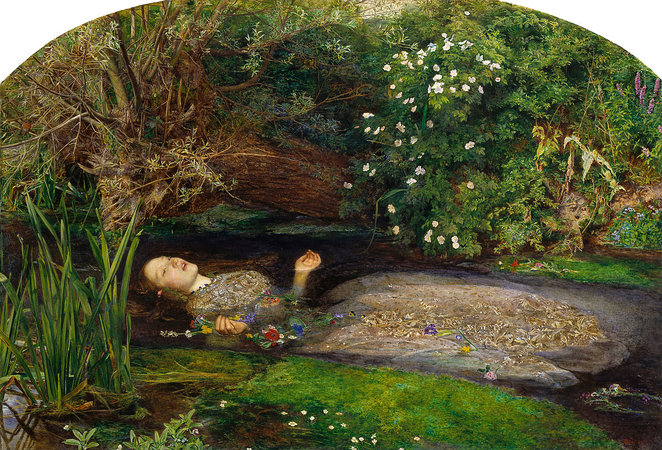
Ophelia, by John Everett Millais, 1852

Religion and sex have a deep intrinsic link, there is not one without the other. Both creation myths and sacred texts record the exploits of the Gods and are entwined with erotic symbolism. The link between sex and creation could be described as unifying, they are inseparable, creation myths are bound to contain sexual references for the universe, the earth itself even mankind are "birthed" from the Gods, the act of birthing, reproducing, requires sex. The waters of life can be compared to either the seed of God or the amniotic fluid, or the menstruation of the Goddess. The earliest creation myth is that of Sumerian and the Goddess Nammu, she gave birth to both Heaven (An) and Earth (Ki), her name means Sea, and the abode of these Gods was the primordial Sea, Apsu, which lay between the earth and the underworld and whose power was lifegiving, simply, the waters of life. Enki is the lord of Waters and Lord of Semen. Apsu, ruled by Enki, is both a realm of the creating forces of life but a place where the soul passes on its journey to the underworlds. In one Egyptian creation story Atum was said to raise out of the waters of Chaos, he created Shu and Tefnut through references to bodily fluids including masturbation, sneezing, spitting and vomiting. Shu and Tefnut give birth to Geb and Nut (the earth and sky) They were fixed in a state of constant copulation until separated to maintain order (Maat), , much like Gaia and Uranus in Greek mythology or Donn and Danu in one variant of Celtic creation stories. and so Nut would rain upon Geb and he would grow things upon the earth. The sun would be birthed by Nut each morning then pass through the sky throughout the day until the sun was swallowed by Nut (sunset) and would be birthed through her vagina each morning, a constant cycle of life, death and rebirth.The Goddess Aphrodite was born from sea foam, invoking evocative  images of a maiden and sperm and the creative waters of life from which we are born. The waters of life and birth, a sexual primal life force, are mirrored in human life through our reproductive acts and when we engage in sex we are uniting our consciousness to that of divinity and the God's that birthed us. 
(For some more creation myths visit: bigmyth.com)

The story of Isis and Osiris is the ultimate journey of Sex, Death and Rebirth and the evocative bond between them. Osiris is murdered by his jealous brother Seth, whom traps him in a coffin made specifically for Osiris, it is nailed shut and sealed with molten lead before being cast into the Nile killing the God. Isis mourned for her husband and searched for his body, she found it and hid his coffin. Seth discovered the coffin and in rage cut Osiris into pieces before scattering them into the Nile. Isis and her sister Nephthys searched for the pieces. They could only find 13 however using magic they formed his likeness but there was one part missing, his penis. Isis fashioned his member then recreated Osiris. She made love to his body and became pregnant with the solar God Horus whom she birthed to avenge his father. The story contains the ultimate mystery of life for it portrays death, sex and birth, and how they are interconnected, a never ending cycle to which not just humans, but the divine forces of the universe are privy. In Greek mythology Gaia and Uranus copsulate, but Uranus is cruel, so Kronos, their son, slays his father. Kronos and Rhea copulate and birth Zeus, who again, in a great cosmic cycle, slays his cruel father Kronos.

Relief of Isis Copsulating with Osiris in form of a bird at Abydos

Eros And Thanatos. The romance of maidens, vampires, valkyries and succubi. “They say there is no light without dark, no good without evil, no male without female, no right without wrong. That nothing can exist if it's direct opposite does not also exist.”- Laurell K. Hamilton, Incubus Dreams
Everybody knows of the libido, our horny state of mind and desires, even though we may shy away from the matter in public, we humans take great pleasure in becoming fimiliar with our sexual arousal however not many people know of their "death drive", a theory which Freud originally proposed. Thanatos (aptly named after the Greek God of Death) is a drive in our subconscious mind which seeks to hurt the organism, the person as a whole, and finds specific pleasure in activities which harm or put the person at risk. Thanatos is directly opposed to Eros (a drive named after the God of Love- i.e pleasure again illustrating the tumultuous relationship between what is essentially sex and death and therefore the two primary components of living)  the drive connected with life, instinct and libido. This drive is concerned with our livelihood, our health, our pleasures and often acts through our sexual drive and instinct. Our mind is dualistic the two drives conflicting yet simultaneously working with, existing with, reacting to one another. The case is similar to that of the existince of life and dark, the cosmic and the natural Yin Yang. The two oppose and compliment one another, by acting with one in mind, the other is therefore prominent, a constant reminder of eachother.

"For every action, there is an equal and opposite reaction"(- Isaac Newton- The Third Law of Motion) for every conscious thought, for every conscious drive and engaging in said action creates the opposite drive, the two are interlinked and our mind is at the zero point, the balance, the space between these two ever present concepts, beings, experiences of life.

The sex and death, light and dark link is very prominent in literature and mythology, and the two are often rightfully placed side by side. A prominent story of the young Maiden Persephone. This is such a romantic vivid invoking story amongst people even of the modern age. Persephone represents everything that is good, pure, she is virginal, a maiden, she is light embodied, she represents the phase between birth and the experiencing of life. She is stolen and taken to the underworld by the God of the underworld, Hades. Hades in this instance represents the darkness, death, the unknown, the unconscious, the other world. Their sacred marraige, sexual union, the corruption of Persephone, lasting six months a year, is a symbol of the young soul venturing into the darkest depths of one's self where darkness, death, spirits, ghosts reside and emerging forth brightly again into the conscious mind empowered, vibrant, glorious radiant, shining with the knowledge gained from before, one big sexual spiritual metaphor. There are similar allegories of the Goddess descending into the depths of the underworld to align either with oneself or the dark God, Inanna, Ishtar, descending as does the shining planet of Venus in the night sky into the dark depths below the horizon to emerge once again, reborn into a new cycle. Psyche is also a young beautiful maiden who comes into an otherworldly sexual union with Eros in the depths of darkness, forbidden from looking upon her lover as they explore their sacred sexuality with one another, she journeys into the realm of Elysium, the otherworld, the subconscious, the darkness. The allure of darkness and light emerging in sexual union has inspired authors, artists, poets for centuries.  The same dualistic theme is similar in the love affair of Aphrodite and Ares, the entanglement of love and war, a goddess of things light, love and childbirth, a God of things dark, violence and rage and war, the female harbinger of sexuality, life and rebirth and the male harbinger of death, darkness, the violence of sexual libido, a dangerous irresistible love affair. This style of romance is so ingrained in our minds, so symbolic and we are so drawn to it because not only does it represent part of ourselves coming together but the different states, processes in our lives that everybody faces.  This compulsion to engage in sex, to stare death in the face, to lose ourselves, our sense of time, of self, for but a moment is both natural and essential to fully understand oneself, to live, to experience the depths of our psyche.

The prominence of Thanatos, this death drive, the intrigue of death and darkness and its arousing close association with sexuality contributes to the eroticised experiences of creatures of the night, the dark denizens hidden within the shadows that we are mortally drawn to and whom are equally ensnared by us, like a moth to a candle flame, for we are the opposite to them. There are so many similar beings in different cultures and lore of a dark body that pries upon us sexually, that draws our life force and although we humans fear them we can't resist them either, terrifying and beautiful. There are the succubi who emerge through the door of the netherworld within our journeys to the otherside in our sleeping state. Nightmarish in their tellings, female demons who have sexual intercourse with sleeping men, equally the Incubus the male counterpart.Their goal is to reproduce, either by collecting semen or impregnating innocent women. Although frightening and demonic these beings are often portrayed in all forms of art in an erotic manner, as attractive, voluptuous or sexualised, or alternatively as a goblin like creature but still placed beside eroticised pictures of young female victims. This parallels the mysteries and old tale of the hapless maiden Persephone being wooed by Hades in the dark underworld where she births their offspring.

Vampires were also a horrible grim creature, defintely thought of as ugly, decaying human monsters arisen from beyond the grave. People used to go to desparate measures to prevent  these creatures from rising, steaking them to the ground, weighing them with stones, there was an apparent paranoia, the idea that something could one day rise beyond the grave and yearn for a taste of the living, their life force and energies, was so real enough that that they took action against it, a public acceptance of a belief. But overtime the vampire has become another undead subject of romanticism. Bram Stoker's Dracula helped formulate the modern lore of vampirism we know today, Dracula craved a mortal maiden Mina and she eventually is hypnotised by his spell. It holds the symbolism of life and death craving to come together in sexual union, the same partnership eternal in our folklore.

“His face was a strong, a very strong, ​aquiline​, with high bridge of the thin nose and peculiarly arched nostrils, with ​lofty​ domed forehead, and hair growing scantily​ round the temples but ​profusely​ elsewhere. His eyebrows were very massive, almost meeting over the nose, and with bushy hair that seemed to curl in its own ​profusion​. The mouth, so far as I could see it under the heavy moustache, was fixed and rather cruel-looking, with peculiarly sharp white teeth. These ​protruded​ over the lips, whose remarkable ​ruddiness​ showed astonishing vitality in a man of his years. For the rest, his ears were pale, and at the tops extremely pointed. The chin was broad and strong, and the cheeks firm though thin. The general effect was one of extraordinary ​pallor​.
Hitherto​ I had noticed the backs of his hands as they lay on his knees in the firelight, and they had seemed rather white and fine. But seeing them now close to me, I could not but notice that they were rather coarse, broad, with ​squat​ fingers. Strange to say, there were hairs in the centre of the palm. The nails were long and fine, and cut to a sharp point. As the Count leaned over me and his hands touched me, I could not repress a shudder. It may have been that his breath was rank, but a horrible feeling of ​nausea​ came over me, which, do what I would, I could not conceal." - Bram Stoker, Dracula

Even though Dracula is described as far from attractive by anyone's ideals the allure of a vampire with unnatural qualities and abilities, who can turn us to lover or pray on its whim is desirable. Today's portrayals of vampires are ones of sexy, film star like people with an unearthly beauty and a thirst, for not just our blood but to copsulate with us, that can not be quenched.

More creatures arise from the dark waters of chaos and sexuality such as the mermaid, the siren, erotic, breathtaking women who would appeal to their male prey, seducing them before dragging them deep into their watery grave. The link between sex and death, light and dark, coming together in the waters of the otherworld, or the subconscious, and our desire to reach these planes of terrifying but blissful states, the Elysium we all strive for, is irresistible even at the cost of death.

The Fisherman and the Siren, by Frederic Leighton, 1856-1858


Even nature spirits such as nymphs and dryads, beautiful feminine beings one can compare to the God's and Goddesses, caretakers of the realm, beings of both light and nature, the living, are sometimes savage and dangerous to encounter. Take Orpheus, his fate was to be torn apart by Maenad's, the female followers of the Nature God of wine, ecstasy and intoxication, Dionysis. The trials of Orpheus are even venturing the tenuous line of death and mortality by venturing to the underworld in order to unite with his fallen lover. The fate of Hylas, who encounters a nymph while fetching water from a pool, is not revealed but one can imagine it either ends in drowning less likely romantically, however the theme of seduction and the otherworld are still prominent subjects.

 Death of Orpheus, by Émile Lévy, 1866

Similarly maidens of light, godliness, sexuality, purity and innocence are also erotic and invoke our sexual instinct and in tandem our urge to connect with spirit and the otherworld.

Swan maidens are prominent in Northern European folklore and mythology. The tale of Angus and the swan maiden tells us of a hero whom in his dream state envisions a beautiful maiden whom he falls in love with. However she is a shapeshifter who changes form between a swan and a woman. Angus has to distinguish her amongst other swans on a particular night, or else she would remain so for twelve months, and propose to her. The imagery is angelic, pure, beautiful and encourages us to travel beyond the realms of the norm and seek out blissful union in an otherwordly state.  Swan maidens have guided male characters in folklore, the imagery so profound to our mortal selves.

"In fact, European folkore abounds in stories of fairy-like swan maidens who usually appear in group of three, or seven. Stories handed down across countless generations thell of them arriving at a lake where they remover their swan shift (or 'wings') and swan ring (that is, a necklace, like Caer's gold chain), which is left behind in the grass. A peasant then comes along and, on seeing the women, steals their belongings and watches from a safe distance. Once the maidens tire of their play, they approach the man and ask for return of what is theirs, at which he requests that if one one of them becomes his wife, then the others might also go free. This then occurs, enabling the peasant and swan-maiden to live as man and wife for seven years, until he shows her, or she finds, the shift and ring that he has concealed for all this time. On holding these she immediately makes her escape, causing her husband to die of heartbreak"- Andrew Collins, The Cygnus Mystery

These teasing, beautiful, pure, elusive maidens are so magical and tempting their tales aren't just bound to Europe.

"All over Europe, and  across Asia alsom the tale is more or less the same".- Andrew Collins, The Cygnus Mystery
In his book, The Cygnus Mystery, Andrew Collins presents an interesting, persuasive, thought provoking hypothesis that these maidens are likened to swans as they are a part of a neolithic global shamanic religion that see the swan as the guide to through the milkyway into the cosmic afterlife, a symbol of a ferryman of souls, a psychopomp, due to the constellation of Cygnus alligning in the milkyway, the waters of chaos, of rebirth, of life and death, and therefore these young fertile maidens symbolise beings from this cosmic, otherworld, they are beautiful and alluring as they represent our desire to travel, to experience beyond our dimension, and that experience, that worshipping of the otherworld and the afterlife is eternally linked to our drive to live, experience, reproduce, our sexual drive. Proof of the swan being a symbol of the after life, or the other world, is also described by Andrew Collins, I recommend reading his book, but here is but one example:

"Traditions of this sort hark back to an age when magical flight was thought to be attained by the male or female shaman through wearing either a cloak of swan feathers or other swan paraphernalia, evidence of which occurs in these same countries, and also in many parts of Asia and the Indian sub-continent, where swan veneration was prominent in the past. Moreover, in Denmark archaeologists have discovered a unique burial in a cemetery dating to the Mesolithic age, c. 4800 BC. A young woman was found beneath a small knoll, next to her dead child, who had been laid to rest on a swan's wing. Its striking presence has been seen by some archaeologists as evidence of a link between the swan and the transmigration of the soul. If correct it shows the antiquity of this cult, which preceded even the spread of Europe's megalithic culture, of which both Avebury and Newgrange are prime examples.

Yet the connection between swan-maidens and prehistoric tombs is not confined to Newgrange, for at the Wayland Smithy long barrow situated some 40 kilometres (25 miles) from Avebury, a legend connects the founder Wayland, or Weland, the Germanic and Norse divine smith, with the cult of the swan. It was written that he escaped from the labours imposed on him by the wicked king Niðuð by wearing a swan coat, enabling him to achieve magical flight. In some versions of the tale, this was given to him by his wife, who was a Valkyrie. They were female spirits, shape-shifting swan-maidens, who carried the souls of the dead to Valhalla, the Hall of the Heroes in Norse myth. Although Wayland's link with the monument that bears his name post-dates its construction by some 4,000 years, it cannot be coincidence that, quite separately, prehistorian Professor John North determined that Wayland Smithy is aligned to Deneb, suggesting that a swan cult existed here as early as c. 3700 BC, its accepted date of construction."- Andrew Collins, The Cygnus Mystery, article on his website: http://www.andrewcollins.com/page/articles/thecygnusmystery_knights.htm

 Another light being, closely meandering the road between sexuality and death, is that of the beautiful Valkyries from Norse mythology. The valkyries are a host of maidens who determine both whom dies and who lives in battle, their name meaning "chooser of the slain", who use their "malicious magic to ensure that their preferences in this regard are brought to fruition".

 "In the religion of the Norsemen, swans were seen as Valkyries, shapeshifting female warriors, gathering around the God Odin and his wife Freya in Valhalla, where slain warriors are recieved into the afterlife. Indeed valkyries were the 'conductors of souls to the lands of shades'. Belief in their visitations to the physical world were widepread in he scandinavian countries, where ancient tradition speaks of maidens adorning themselves..."- Andrew Collins, The Cygnus Mysterey

Often compared too with swans, or horses, they are empowered, beautiful ladies who not only exist beyond the veil they hold the reigns on the livelihood of men, literally deciding who lives and who dies, sex and death embodied, whom sometimes fall in love with heroes and men alike.

 "The meeting of two personalities is like the contact of two chemical substances: if there is any reaction, both are transformed. "- Carl Jung

Ultimately it is the attraction, the draw, the impulse we each have to explore, to lose oneself in sexual activity that beckons us towards connecting to the divine, walking the footsteps of Gods and fantastical beings alike, to enact the throes of heroes, of demons, of human beings, of particles alike, an intrinsic part of our very being, our very psyche which helps us understand ourselves and hand in hand come to terms with the aging of our being, the maturing of our soul, the demise of our simply physical, material selves, but an invitation to experience the floodgates of the world beyond the veil, to open our eyes to ecstatic realities full of beautiful maidens, of heroic knights, of dark sultry demons, incubi, succubi, vampires, of men and women so sexual, so irrestible every fibre of our being can not deny the impulse to align the light with the darkness, a journey of self discovery for "one does not become enlightened by imagining figures of light, but by making the darkness conscious"- Carl Jung, a human experience from one to another, no matter how drunken, how debaucherous, how raunchy we are all learning, experiencing, living, creating, uniting our primal animal with our enlightened oneness, "To confront a person with his own shadow is to show him his own light"- Carl Jung.

Perhaps this urge to unite the darkness with the light, the sexual with the otherworld beyond,  is where fetishes are born, people diving into the depths of their darkness, the Thanatos taking over, sado-masochism born by experiencing our own mortality literally as we experience the sense of self gained through sex, the release of a drive that governs our waking moment for it defines what it is to be alive.

Perhaps this merging, this willingness to submit, to perform this act aware of the barrier breaking, transcendental sense of being, is so frightening we fashion images of maidens corrupted by their desires, the whore is so self empowered, so awake in her divinity, her sexual awakening, we fear her, make her monstrous, paint her as the whore of Babylon. We are so scared of mortality, of living, we curse the primordial Eve, Lilith, for teaching us that we are mortal, that we are sexual beings, that we can die, experience more than this safe bubble of reality. We curse her and the serpent, the very symbol of knowledge, of the pineal, of the rising energy of the Kundalini which is risen by the very act of being, of existing, by reaching transcendental experiences in whatever medium YOU find fit for your purpose, INCLUDING sex. We have demonised the old, ancient, sacred, enlightened priestess who guided us, who sustained us with her living fluids, her sexual energies. Paint her as a whore:

"The ’Scarlet Women’ were so called because of their being a direct source of the priestly Star Fire. They were known in Greek as the Hierodulai (’Sacred Women’) - a word later transformed (via mediaeval French into English) to ’harlot’. In the early Germanic tongue, they were known as Horés - which was later Anglicised to ’whores’. However, the word originally meant, quite simply, ’Beloved Ones’. As pointed out in good etymological dictionaries, these words were descriptions of high veneration and were never interchangeable with such words as ’prostitute’ or ’adulteress’. Their now common association was, in fact, a wholly contrived strategy of the mediaeval Roman Church in its bid to denigrate the noble status of the sacred priestess."- Laurence Gardner

Lilith, by John Collier, 1892

To engage in the act of sex is a natural, empowering experience, we are programmed to do so, it is hardwired deep in our subconscious, whether that be with a loving partner where you can awaken the depths of eachother, experience romantic bliss, or even a stranger. Life is about experience, and sex is the ultimate link to living for it is spiritually and psychologically connected to dying, and the more prepared we are for our travels, our journey to the fields of Elysium, the less we have to live in fear, denying and imprisoning apart of ourselves into the tales of history, into the twisted mythology of monsters. Live, experience, love, make love, dream, go beyong the veil, walk on the shoulders of Giants.

 "Through spiritual unfoldment and knowledge imparted by the Mysteries, however, the latent element in each nature is gradually brought into activity and ultimately the human being thus regains sexual equilibrium. By this theory woman is elevated from the position of being man's errant part to one of complete equality. From this point of view, marriage is regarded as a companionship in which two complete individualities manifesting opposite polarities are brought into association that each may thereby awaken the qualities latent in the other and thus assist in the attainment of individual completeness."- Manly P Hall, The Secret Teachings of All Ages
 
So please, go forward, my fellow journey men, be conscious that you are alive, experience the wonders of nature, of material existence, the ecstasy in your sexual empowerment, the freedom to love and unite with another, there is nothing more divine than being truly in love with someone and exploring that relationship. Awaken the darkness and balance it with your light, travel to worlds beyong and love yourself and another. Be conscious of this bond, for "man is not truly one, but truly two,”- Robert Louis Stevenson, The Strange Case of Dr Jeckyll and Mr. Hyde.Safe journey on your travels, and to you, Namaste.

Freya Rose
)O(


References/ Sources

Books:
Genesis of the Grail Kings- Laurence Gardner
Realm of The Ring Lords- Laurence Gardner
The Cygnus Mystery- Andrew Collins
The Secret Teachings of All Ages- Manly P Hall
Bram Stoker- Dracula
The Strange Case of Dr Jeckyll and Mr. Hyde- Robert Louis Stevenson

Websites:
Bigmyth.com
industry-couldnt-get-worse/
https://thoughtsfromthemiddleseat.com/2011/02/28/explaining-thanatos-the-death-drive/
http://www.andrewcollins.com/page/articles/thecygnusmystery_knights.htm
http://www.bcliving.ca/health/5-surprising-ways-sexy-time-is-practiced-around-the-world